
Imagine you’re about to take a high-leverage futures position on BTC, your chart is set up, and the spread looks acceptable — but you can’t get past the login screen. This is an ordinary moment with high stakes: access equals the ability to act (or to close a position). For US-based traders using OKX, “login” is not just entering credentials; it’s the intersection of identity rules, platform security, and a hybrid Web3/CEX architecture that changes both convenience and risk. This article walks through how OKX Web3 login and verification actually work, where friction comes from, what it protects, and which trade-offs matter for active traders.
I’ll assume you know basic wallet vocabulary (seed phrases, private keys) and basic exchange concepts (spot, margin, futures). What follows is mechanism-first: how the systems are designed, how that affects usability and safety, and practical heuristics you can apply when you—and your capital—are on the line.
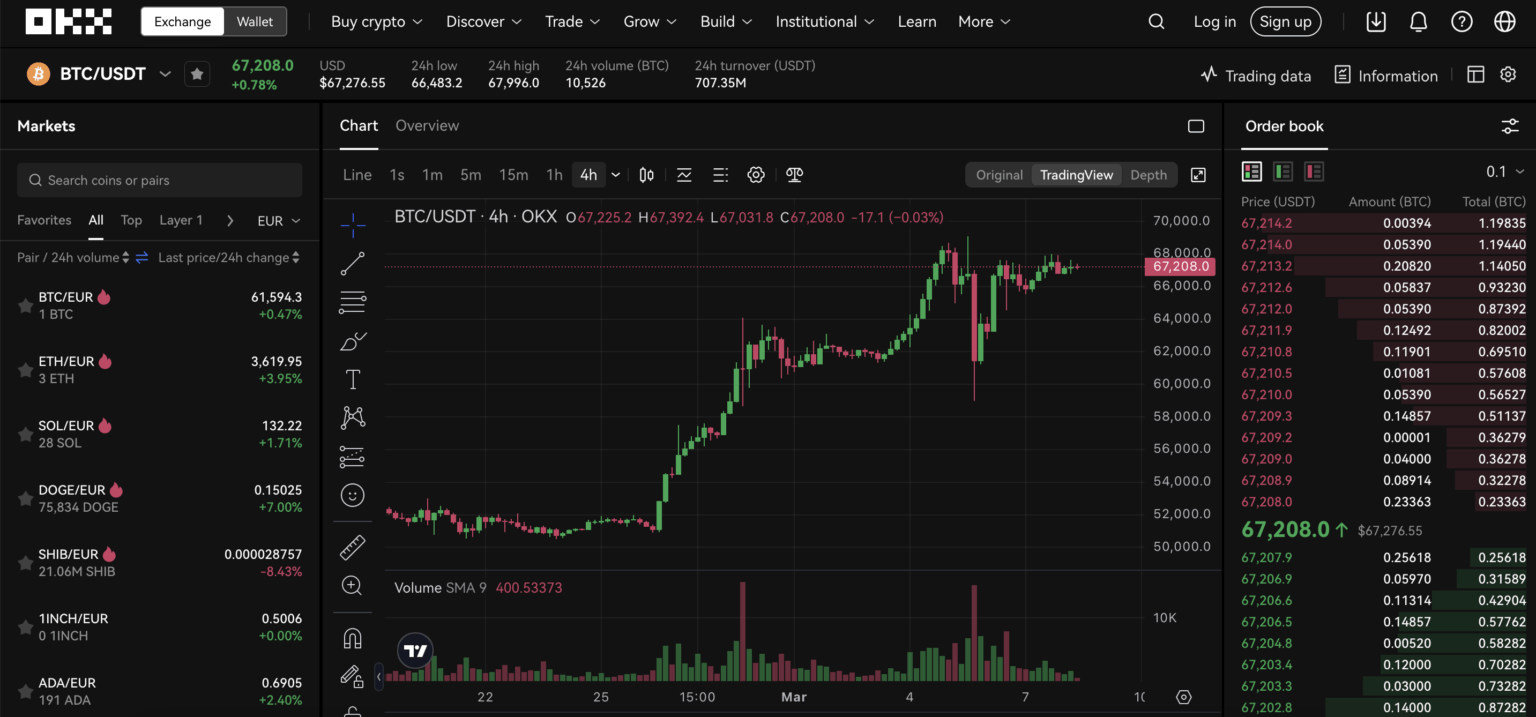
How OKX login and Web3 access are engineered
OKX operates as a hybrid platform: a centralized exchange (CEX) for custody, order matching, and product rails (spot, margin, futures, options) and a Web3 wallet layer that can be non-custodial. The login sequence therefore has two related but distinct purposes. First, authenticate and authorize a CEX account so the exchange can apply KYC rules, custody assets, and enforce trading limits. Second, enable Web3 interactions (connecting a self-custodial wallet or a browser extension) so you can interact with on-chain DApps and the OKX DEX aggregator.
In practice that means the standard OKX login flow for US users combines password entry, Two-Factor Authentication (2FA) — SMS, Google Authenticator, or biometrics on mobile — and AI-driven risk checks that flag unusual device or IP behavior. If you want to use the Web3 wallet features, the platform prompts you to connect a seed-managed wallet or hardware device. For newcomers, OKX also requires formal identity verification (KYC) that involves a government ID plus a liveness (facial recognition) check; this is mandatory because the exchange is a regulated touchpoint for fiat and derivatives.
Why verification (KYC) matters — and where it constrains traders
KYC is often framed as “bureaucracy,” but for derivatives traders in the US, it is functional: exchanges that offer margin, futures up to 125x, and fiat on-ramps must enforce AML/KYC to maintain banking relationships and regulatory compliance. The trade-off is simple: completing identity checks unlocks product access — margin, higher withdrawal thresholds, and futures — but it also creates permanence. Once your identity is attached to an account, remediation for mistakes (like unauthorized trades or disputes) follows legal and institutional channels instead of anonymous recourse.
Mechanically, KYC adds friction and latency. Expect verification turnaround times that vary with volume and document clarity. In fast-moving markets, that latency is meaningful: if you haven’t completed KYC, you may be barred from opening certain leveraged positions or making large withdrawals at the moment prices move. The practical heuristic: for active traders who want to use OKX derivatives, complete KYC well before you need it and verify your 2FA and device permissions so login checks don’t lock you out during a market event.
Security architecture: where convenience and control collide
OKX uses a layered security approach. Over 95% of custodial assets are claimed to be held in offline, multi-signature cold storage — a design that reduces systemic theft risk but does not eliminate account-level threats like phishing or credential compromise. On the login side, real-time AI-driven anomaly detection watches for suspicious logins and can force extra verification steps.
The Web3 wallet option, by contrast, is non-custodial: you control the seed phrase, and OKX provides integrations for hardware wallets like Ledger and Trezor. That preserves censorship-resistance and control, but introduces user-side risks (seed loss, social engineering, and smart contract vulnerabilities) that are outside the exchange’s remit. In short: custodial login protections protect against exchange hacks; non-custodial control protects against custodial failure — but both have distinct threat models.
Common myths vs realities
Myth: “KYC makes trading less private but doesn’t help security.” Reality: KYC itself doesn’t secure your password, but it prevents fraudsters from using the exchange anonymously and allows the platform to freeze accounts tied to illicit activity; however it also centralizes identity which could be targeted in legal or compromise scenarios.
Myth: “Using the Web3 wallet is always safer.” Reality: Self-custody reduces custodial risk but increases user-responsibility. A lost seed phrase is irreversible; a hardware wallet mitigates that but adds complexity. The decision isn’t strictly safer/less safe — it’s a trade-off between institutional safety and individual control.
Myth: “Login delays are only due to bureaucracy.” Reality: Many delays come from risk-detection algorithms that intentionally add friction (like temporary blocks) when they see atypical patterns. Those algorithms aim to stop account takeovers and money laundering, but they can also create false positives during legitimate cross-device use.
Practical login checklist for US traders
1) Pre-verify: Complete OKX KYC and set up 2FA before you plan to trade futures or large positions. Verification removes sudden access blocks for regulated products.
2) Separate custody by intent: Use the custodial account for exchange trading and the non-custodial Web3 wallet for DeFi and NFT activity. Avoid mixing large quantities across both without clear tracking.
3) Harden accounts: Enable hardware-backed 2FA where possible, and register known devices. Use biometric login on mobile for convenience but keep a secure 2FA backup.
4) Practice recovery: Test your hardware wallet or seed phrase recovery process in a low-risk way. Practice a simulated account recovery with a small test wallet so you understand the steps under stress.
Where the system breaks — limitations and unresolved issues
There are several boundary conditions traders should know. First, automated delistings (for example, routine removal of low-liquidity assets) can remove trading pairs with little notice, which affects positions in smaller tokens. Second, AI risk systems can produce false locks during high-volatility periods when traders are most active. Third, proof-of-reserves increases transparency, but it doesn’t guarantee uninterrupted access or immutability of off-chain processes like KYC decisions. Finally, cross-chain interactions via the OKX DEX aggregator reduce manual bridging friction but introduce smart contract and liquidity routing risk: the cheapest route on paper can be the riskiest in execution if a bridge or DEX has a vulnerability.
In short: login and verification protect many forms of risk but cannot eliminate market, smart-contract, or personal operational risks.
Decision-useful takeaways and a simple mental model
Think of OKX access as three concentric rings: public access (view-only), custodial access (trading and withdrawals under KYC), and self-custodial Web3 access (seed-controlled interactions). Your choices should map to the role you play. If you’re an active US derivatives trader, prioritize completing KYC, hardening 2FA, and separating custody. If you’re a Web3 user focused on DeFi, prioritize hardware wallets and careful contract interaction over exchange convenience.
Monitor three signals that should change behavior: sudden changes in withdrawal limits or KYC policy from the exchange (operational risk), rapid increases in page or API login challenges (possible targeted attacks or regulation-triggered friction), and delistings of traded pairs (liquidity risk). The recent practice of routine delistings underscores that exchanges actively manage listings — smaller tokens can disappear quickly.
For step-by-step login guidance and a troubleshooting primer, see this resource on OKX login which walks through common issues and recovery options: okx login.
FAQ
Q: Will completing KYC speed up my trading access?
A: Yes. Completing identity verification is typically required to access margin and derivatives products and to raise withdrawal limits. It doesn’t remove all friction — real-time security checks can still trigger — but it reduces hard blocks tied to lacking identity information.
Q: If I use the OKX Web3 wallet, do I still need an exchange account?
A: Technically no for purely on-chain activity; you can use a self-custodial wallet to interact with DApps. But for fiat rails, centralized trading, and certain derivatives, an exchange account with KYC is required. Many traders keep both for different use cases.
Q: What should I do if my login is flagged as suspicious during a market move?
A: First, don’t panic. Use verified recovery channels: confirm emails from the exchange, use 2FA backups, and if necessary, contact support through official channels. Avoid sharing credentials or following links from unexpected messages — phishing spikes during market volatility.
Q: How does OKX’s Proof of Reserves affect my decision to keep funds there?
A: Proof of Reserves increases transparency about aggregate custody but doesn’t change counterparty, operational, or regulatory risk. It’s a useful signal that assets are backed on-chain, but it doesn’t replace personal security practices or diversification of custody.
Final practical note: treat access as part of your risk surface. Strong login hygiene, early KYC completion, and a clear custody strategy are not bureaucratic chores — they’re tactical moves that determine whether you can execute when it matters. Keep monitoring product changes like delistings and platform announcements; they are the operational weather that affects execution risk in real time.